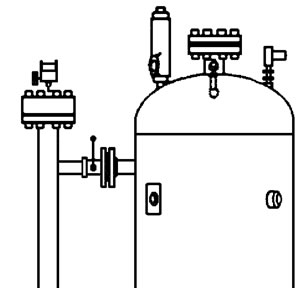
A stem-guided, stainless steel, poppet-type disc (Item 1) closes against the stainless steel seat (Item 2). Closing force is normally supplied by accumulator pressure acting on the valve disc; at very low accumulator pressure, such as is experienced when starting up, a stainless steel spring (Item 3) supplies sufficient pressure on the disc to ensure closure.
As the disc nears the seat on closing, a cushion is formed through control of the air flow out of the air cylinder (Item 4) by adjusting the speed control valve (Item 5). This cushion prevents damage to the valve when the pressure differential across the seat is great.
Once the valve has closed, air pressure to the cylinder alone will not open it. The pumps must be used to create pressure in the system equal to that in the accumulator. Only when this balanced condition exists can the valve be opened by pilot pressure. This prevents accidental opening of the valve, which could prove disastrous. As a final safety feature, only one static seal is exposed to accumulator pressure.
Elwood Shut-off Valve used in a Typical
Accumulator System
No two installations need be exactly alike with regard to arrangement of pressure and liquid level devices. Elwood recommends, however, that both pressure and liquid method of control be used. A proper relationship of pressures and levels must be maintained at all times or complications will result. In the illustration at the right, one type of pressure sensing device and two types of level sensing devices are shown. The simplest combination involves float switches (A) and pressure control (B). The upper float switch opens on rising level to shut down pumps. The lower float switch opens on falling level to close the shut-off valve (C). The level control (D) will have sufficient switch contacts to load and unload the pumps, thus maintaining levels between normal low and normal high.
The level control (D) is, in effect, a level sensing device which receives its input signal from the height of the fluid in the bottle. A little more complicated than the float switch, it gives an output signal for all points of level within its range. This is necessary if remote indication or recording of level is required. Control of any components by means of switches can be arranged to suit the user’s requirements.
Due to the fact that many variations and combinations of controls can be arranged, we suggest contacting the Elwood Engineering Department when a system is being planned. |